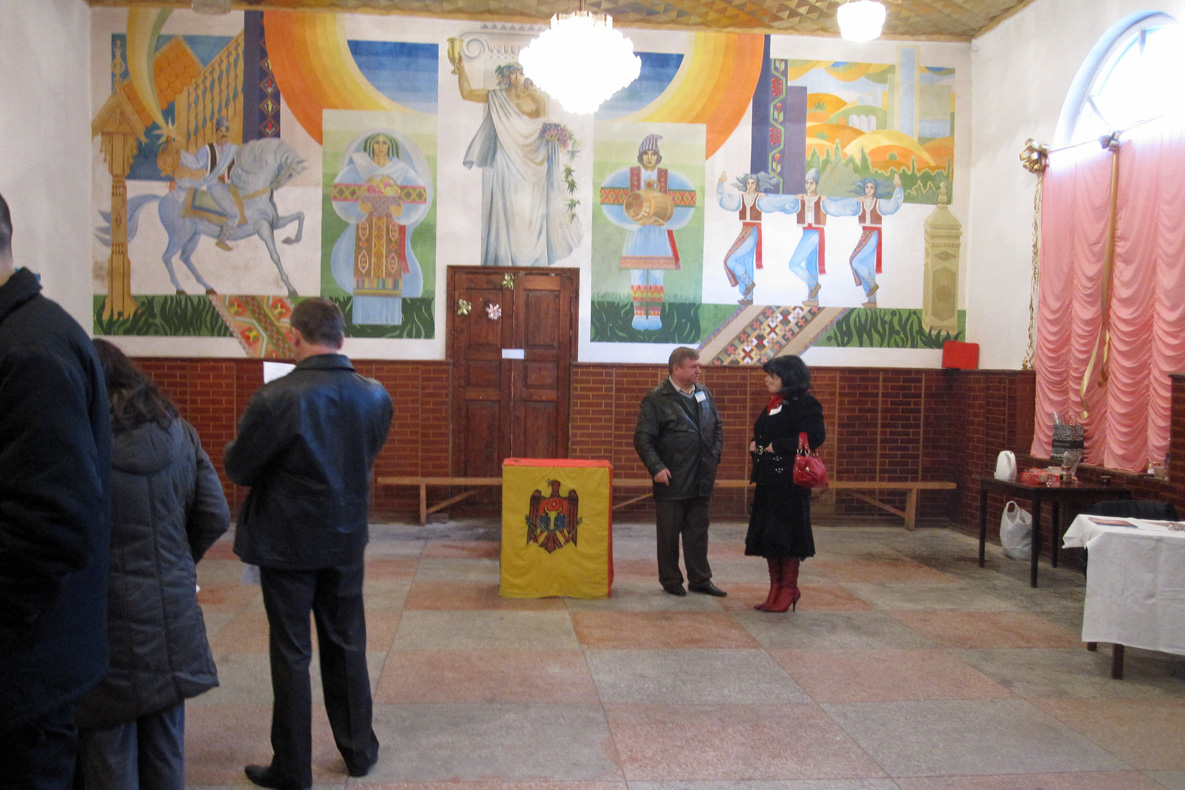
On election day, Erik and his team awoke early to attend a poll opening in the city of Ialoveni. They traveled from village to village during the morning hours, stopping in several polling stations and talking with officials. In the afternoon, they explored another part of the region and settled on observing the final vote count in Ialoveni. Overall, Erik observed a straightforward and well-managed process. Mistakes were made - generally by officials who privileged speed over accuracy in their preparations or vote counting. That is, officials understood the rules but took shortcuts, and those shortcuts caused them to make mistakes. They ended up spending more time instead of less as they backtracked and fixed the mistakes.
Above, officials prepare to open the polling station. Among the twelve polling stations we observed was the one below - appropriately located in a wine factory. Note the fantastic mural to Bacchus in the background.
Sometimes, the act of observation affects the process. Below you will see a few green banners. Erik noticed them when the team arrived at a station. The polling site was quite close to the local headquarters of a political party. However, they had hung extra banners well withing the 50 meter limit (no electioneering was permitted within 50 meters of a polling station entrance). Erik paced out the distance and took photos, then headed in the polling site to observe.
The "after" photo is below. Erik's activities did not go unnoticed, and someone removed the banners. The team checked back later in the day, and the banners were still gone. The remaining green banner is the HQ's official sign. While it should not be within the 50 meter radius either (technically), it is not a campaign sign.
The village above prepared for the election by hanging lovely flags everywhere. In many polling sites, the atmosphere was festive, with traditional Moldovan music blaring from loudspeakers. Below you can see one of the stars of the election - not the woman glaring at Erik, but the ballot itself. It was about 3 feet long and included 20 parties and 19 independent candidates.
Below, you can see Lili, the team interpreter, casting her ballot. She obtained an absentee certificate, allowing her to vote in any polling station. We were particularly enamored of this village site, located in the old Soviet-era "House of Culture." So, Lili decided to vote there.
Below you see Tigran at work. We took turns asking questions of the polling station officials while the other walked around inside and outside to observe the process. Splitting up can be an effective way to find interesting things (such as the banners noted above).
The photo of the vote count above does not fully capture the chaos and energy in the room. It reminded Erik of those glass booths in which money blows around and carnival-goers try to grab as much cash as they can. In this case, ballots flew about willy-nilly, landing in piles like the ones below.
Moldova's politics are quite contentious. Last Sunday's election was the third since spring 2009. Moldova's parliament elects the president, and if the super-majority of 61 out of 101 deputies cannot agree on a candidate, parliament is dissolved and new elections are held. Parliament failed to elect the president twice in 2009, but the constitution prohibited another dissolution for a year.
Above you can see a poster that says "No Mafia." It is an advertisement from a small party that opposed the activities of a particular businessman in the elections. However, this party never had a real chance of gaining seats.
The Communist Party is Moldova's strongest contestant, enjoying support in small towns and villages outside the capital region and in ethnic minority regions like Gagauzia. The opposition is perpetually divided, and four main opposition groups vied for seats this round. The results, announced last Monday, unfortunately do not resolve Moldova's gridlocked political scene. The Communists garnered the most seats followed by three opposition parties. Neither side has the requisite 61 votes to elect the president.
Erik planned to return home on Tuesday, but his flight to Munich was canceled. He and other observers spent much of the day standing in line to rebook. On Wednesday, he almost missed a connection in Frankfurt because of Air Moldova's delayed departure and its exile to a remote part of the airfield. For those of you who don't travel to Europe, planes often do not use jetways. Instead, they park on the airfield and buses take passengers to/from the plane. Erik suspects that Air Moldova has poor parking privileges, resulting in its bad parking place. The jet taxiing and bus transit legs of arrival in Frankfurt only gave him a scant 40 minutes before departure. He ran to the gate, but was delayed by unsympathetic security personnel who would not expedite his movement through the line. He found an ally in an Indian woman who was also hoping to get on the plane - they tried several approaches to get through, but were rebuffed. When he finally arrived at the gate, he was told that the doors were closing and he could not get on the plane. After a - let's say assertive - conversation, the Lufthansa employees relented and let him on. His new Indian friend and a young American couple finishing their Peace Corps duties in Turkmenistan also made it on, but some colleagues from the OSCE did not. Erik's bag did not make it, although it finally arrived on Friday afternoon.

The final photo is a view from the airport as Erik was standing in line to rebook. Despite some of the bumps, the journey to Moldova was a success. It is a lovely country that has great potential.