 St. Nicholas' Day (or St. Mykolai in Ukrainian) on December 19 launches the long winter holiday season. Good boys and girls are visited by St. Nick at night, and he places a gift under their pillow.
  During Soviet times, children were visited by the more secularly-oriented Дед Мороз (Grandfather Frost) on New Year's. On the eve of St. Nicholas' Day, the holiday tree erected in front of the Opera House was dedicated and fireworks lit up the night sky [No political correctness here as the tree is not a "Christmas tree" per se, but rather one that will mark several holidays]. We have already posted about the Ukrainian love for holidays, so it will not surprise you that over the course of the next month, at least five major holidays will be marked by many citizens of L'viv. After St. Nicholas Day, the Roman Catholic Latin Rite Christmas arrives. I have been told that even though Byzantine Rite Catholics celebrate Christmas on the Orthodox calendar in January, people often celebrate December 25th as well. Following Christmas is New Year's Day, then Byzantine Catholic/Orthodox Christmas, and finally Old New Year. Rather than completely adhering to the Gregorian calendar adopted by the Soviets, the New Year is celebrated according to both the Gregorian (January 1) and Julian (January 14) calendars. While officially many institutions remain open for most of this period, it is often treated as "down time."
 On Tuesday, Yuliya Tymoshenko finally received enough votes to become Prime Minister. Erik watched the proceedings on TV, while recovering from two consecutive nights on the train. You can see the photos of her triumph on Korrespondent's website. Tymoshenko received the bare minimum necessary - 226 votes. Members of parliament voted by raising their hands and recording a voice vote one by one because of suspicions raised about the electronic voting system. Also, having deputies record their vote publicly is an easier way to hold them to the party line. Ivan Pliushch, a dissenter from the president's party, voted to abstain. His voice vote was met with disapproval from other deputies in his party. While this is a short-term victory, it presages highly contentious votes on the horizon. Tymoshenko and her allies will have to work hard and fight for every initiative because she cannot rely on disciplined deputies in her coalition to vote along party lines. In addition to Yuliya's elevation to PM, the rector of Ivan Franko National University, Erik's host, was named Minister of Education. Two and a half months after the election, Ukraine now has a new government in place.
 Chornobyl workers lived in Pripyat, a cookie-cutter, model Soviet city. The ironic slogan, serving as the title of this entry, was proudly displayed on the roof of one of the hundreds of abandoned buildings. Well after the explosion and loss of radiation containment, residents received an almost matter-of-fact announcement, part of which you can hear below in the video of contemporary Pripyat that Erik shot from the bus.
"...It is recommended that you take with you documents, indispensable items, and also, in the first case, foodstuffs. Directors of businesses and other institutions should identify a group of workers to stay in their places to assure normal functioning. All homes under evacuation will be guarded by the militia. Comrades, temporarily leaving your home, don't forget, please, to close windows, turn off electrical and gas appliances, and close water pipes. You are asked to keep calm [unintelligible] ... and order during the course of the temporary evacuation."
The people of Pripyat left their apartments assuming they would be back soon, not knowing that most would never see their homes again (save for the lucky few Sasha has helped). Pripyat is now a real Ukrainian ghost town. Abandoned vehicles, too irradiated to leave the zone, are strewn about. The hottest vehicles are in grave sites outside the city. While looters and scavengers have ravaged the town, some evidence of daily life remains.
 Pripyat was readying itself for the May Day holidays; a warehouse still houses large portraits of Party leaders for the celebration. Other evidence of the celebration-to-be is scattered about town. Some objects have been placed in unusual locations, like this musical instrument in a phone booth. Trees grow everywhere, from the pavement and even from the top floor of the local hotel. Climbing to the hotel's observation deck led us through debris-covered floors and stairwells, with peeling paint, broken furniture, wires, and other detritus. I have posted several Pripyat photos below.
The post-apocalyptic landscape was dominated by the sounds of nothing. The eerie silence was broken only by our footsteps on shattered bits of glass and wood. It was also broken in a surreal moment when Erik's phone rang with a call from Victor. It is hard to believe, but in an abandoned city ravaged by a great catastrophe 21 years ago, Erik got a cell phone signal.
Pripyat was our last stop on the Chornobyl adventure. After eating a meal together in Chornobyl - with food imported from outside the Zone - we returned to Kyiv. Erik went to the train station for his second consecutive night on the train, arriving in L'viv on Tuesday morning.


 We arrived at the Zone as a new shift was coming on duty. Dozens of workers filed single file through the gate, re-boarding their buses for the trip to their workplaces. Some work Monday through Thursday; others work two weeks in and two weeks out. All of these workers maintain the Zone and mitigate radiation effects, or provide services to the workers of the zone (like running cafeterias).
After our documents were checked, we passed through the first of several checkpoints. Our initial stop was the city of Chornobyl. Sergey delivered a briefing on the effects of radiation and the good fortune - amid tragedy - visited upon our final destination, the town of Pripyat. Pripyat was a company town of 40,000 residents, constructed specifically for the workers at the Chornobyl Atomic Energy Station. Planners assessed typical wind patterns and situated the city in the safest zone adjacent to the plant in the unlikely event of a meltdown. Their choice was fortuitous as the wind gusts on the day of the disaster sent particulate radiation west. Over the next few days the wind sent radiation to the north and east. Pripyat was placed in the wedge of lower radiation, preserving thousands of lives.
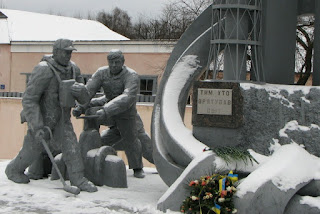
 The Zone has several monuments dedicated to the disaster. The one above was not formally commissioned, but simply put together by workers in the Zone to commemorate the event. Its slogan is the title of this entry. Another memorial at the reactor site honors those who were the first workers on the scene, sacrificing themselves to save thousands of lives (to the right).

 After the disaster, many of the locals who were evacuated returned to their village homes even though they were officially prohibited. Using routes blazed by WWII partisans, a few thousand moved back. Age has claimed many of them, and only a few hundred hearty souls remain. We visited one tiny spitfire who roughs it, relying on her well, garden, chickens, Zone workers, and occasional help from guests. She shared a bit of her tragic life story during our brief visit. Much like the elderly beekeepers we visited in Urich, she was quite hardy and self-sufficient. The difference was the hazards she faced and her solutions. Someone was supplying her wood; probably the lumberjacks maintaining the forests. Of course, the wood she burns for heat emits radiation. If something breaks, she can go to the abandoned homes to find a replacement. But, who will protect her from the wolves that killed and ate her dog?
 Our next destination was the Chornobyl station itself. The great heroism of the first-responders, attacking the blaze and struggling to stop the radiation which was searing their bodies and dooming them to a painful death, is hard to imagine. While 9/11 first responders acted heroically, those who perished did not know that they would die trying to save others. Many Chornobyl first responders knew that doing their duty to save others was a death sentence.
 The tragedy of Chornobyl stretches beyond emergency workers, to a great human and environmental toll. In this context, being a tourist at Chornobyl felt a bit uncomfortable. But, the event is an important moment in world history with long-lasting consequences. Recognizing this, the Ukrainian authorities have constructed a visitor's center at the site. A staff member delivered a fantastic, clear, and detailed presentation on the event and mitigation efforts. An interesting and disturbing fact is that the metal roof of the sarcophagus encompassing the reactor is not welded into place, but rather laid on top. This has allowed water to leach in, endangering containment. In addition, the roof was balanced on an unstable wall, a problem recently relieved by the construction of a steel buttress. The next step is to build a new containment shelter covering the current sarcophagus and extending the shelter's life for 100 years. But, this does not solve the potential problem of what is below.
 "...otherwise it will punish." Like the Holodomor and many other tragedies before it, the Chornobyl [1] accident on April 26, 1986 and its aftermath has become a part of modern Ukrainian folklore. Not only have the real tragedies of the catastrophe scarred the landscape and people, but Chornobyl also infiltrates all areas of Ukraine's life.
Chornobyl means "wormwood" in Ukrainian. Wormwood is the name of an apocalyptic sign in the Book of Revelation, and years ago Erik read of Ukrainians who have made the link between the two. A major Ukrainian video game, S.T.A.L.K.E.R., features action in the Zone with strange mutated creatures. This video game is connected to a classic Soviet-era film by the highly regarded avante-garde director Andrey Tarkovsky. In his movie, Stalker, the eponymous character, leads two men into the mysterious Zone, a wasteland where physical rules do not apply, to seek a room where dreams are made real. The title of this blog entry is a quote from the movie. Even though the movie long predated the disaster, it is connected in many ways.
 Sergey, our main guide, has a long association with Chornobyl. A chemist by training, he was also skilled in radiological, bacteriological, and chemical warfare reconnaissance and was assigned to Chornobyl duty a few months after the disaster in 1986. He ran a brigade investigating hot spots. Sergey is incredibly knowledgeable about the region, with experience as a liquidator and as a scholar. But, his approach sometimes seemed a bit revisionist, labeling the disaster a "victory" and explaining that he believes that future interpretations will refer to "Chornobyl glory." Why does he have a positive spin on the catastrophe? In his view, Chornobyl was a key event leading to the collapse of the Soviet Union. Moreover, it showcased the true heroism and altruism of humans, as well as the ability of the human organism and nature to recuperate.
Also joining us on the trip was Vasyl, a forestry expert. He explained that a large forest fire today could approach the initial disaster in terms of radiation released. Many forestry workers are active in the Zone to reduce the likelihood of such a catastrophic conflagration.
Sasha was our third guide, a survivor of the disaster who now runs the NGO Pripyat.com. Ironically, his last name - Syrota - means "orphan" in Ukrainian. Much like the New Orleans diaspora attempted to retain community connections after Hurricane Katrina through websites and discussion groups, Pripyat.com is an NGO dedicated to preserving the traditions of the region. While we were exploring the town, Sasha visited the abandoned apartments of former residents who contacted him at the NGO to document their condition. This is one of the many services that the NGO provides to the Chornobyl diaspora population.
En route to Chornobyl, Sergey gave several warnings about the wild conditions in the Zone; the Zone is a place with different rules: we should not assume that floors will hold us, or that doors are attached to frames. The limited human prescence has barely mitigated nature's effects, and we were admonished to watch where we walk as open manholes, bare wires, broken glass, and other hazards litter the area.
Nature dominates in other ways as well. We saw a brood of massive wild boars, and we were warned about a wolf pack that had killed local dogs and was stalking the region. While there was no sign of Blinky, the three-eyed atomically enhanced fish from The Simpsons, the local bird populations have shown signs of mutation, with crossed beaks and other deformities. But, aside from some chickens raised by an old woman in a village, I saw and heard no birds.
 What about radiation? While some areas are hotter than others, the group was not exposed to dangerous levels of radiation. Monitors are scattered about the Zone, and the data are reported in real time in many places. In addition, the group had detectors that reported elevated radiation areas, and we were tested before being released at the main checkpoint. Upon our departure from Chornobyl, Sergey checked his radiation level and found that it was equivalent to a transatlantic flight.
[1] Please note that I will use the Ukrainian spelling throughout. You may be more familiar with the Russian version of the name - Chernobyl.
 St. Nicholas' Day (or St. Mykolai in Ukrainian) on December 19 launches the long winter holiday season. Good boys and girls are visited by St. Nick at night, and he places a gift under their pillow.
  During Soviet times, children were visited by the more secularly-oriented Дед Мороз (Grandfather Frost) on New Year's. On the eve of St. Nicholas' Day, the holiday tree erected in front of the Opera House was dedicated and fireworks lit up the night sky [No political correctness here as the tree is not a "Christmas tree" per se, but rather one that will mark several holidays]. We have already posted about the Ukrainian love for holidays, so it will not surprise you that over the course of the next month, at least five major holidays will be marked by many citizens of L'viv. After St. Nicholas Day, the Roman Catholic Latin Rite Christmas arrives. I have been told that even though Byzantine Rite Catholics celebrate Christmas on the Orthodox calendar in January, people often celebrate December 25th as well. Following Christmas is New Year's Day, then Byzantine Catholic/Orthodox Christmas, and finally Old New Year. Rather than completely adhering to the Gregorian calendar adopted by the Soviets, the New Year is celebrated according to both the Gregorian (January 1) and Julian (January 14) calendars. While officially many institutions remain open for most of this period, it is often treated as "down time."


